Choosing the right Learning Management System (LMS) is only the beginning of your digital learning journey. The real challenge lies in implementation. Many organizations invest significant time and money in selecting an enterprise LMS, only to discover that adoption remains low, administrators struggle with manual work, and employees fail to engage with training.
The problem isn’t usually the software itself. It’s the implementation strategy.
Enterprise LMS implementation is far more than installing a platform and uploading courses. It requires careful planning, cross-functional collaboration, clean data, well-defined processes, and continuous optimization. Organizations that treat implementation as a business transformation initiative consistently achieve better learner adoption, stronger compliance, and measurable ROI.
This playbook provides a practical framework for implementing an enterprise LMS successfully. Whether you’re replacing an existing system or deploying your first enterprise learning platform, these best practices will help you reduce risk, improve adoption, and create a learning ecosystem that delivers long-term value.
Why LMS Implementation Is More Than a Technology Project
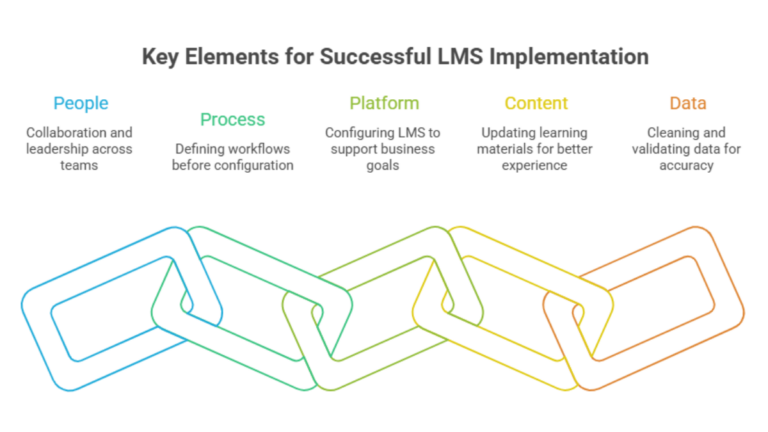
One of the biggest misconceptions about LMS implementation is that it’s purely an IT initiative. While technology certainly plays an important role, successful implementations balance five equally important components that work together throughout the project.
1. People
Every successful implementation begins with the right people. Executive sponsors provide strategic direction, project managers coordinate timelines, L&D teams define learning requirements, IT manages integrations, and administrators maintain the platform after launch.
Without clearly defined ownership, projects often experience delays, conflicting priorities, and slow decision-making. Assigning a single accountable owner for each major decision helps maintain momentum throughout the implementation lifecycle.
2. Process
An LMS should support well-designed business processes rather than compensate for inefficient ones. Enrollment workflows, approval processes, certification renewals, reporting requirements, and learner support should all be documented before platform configuration begins.
Organizations that configure the LMS before defining these processes often end up creating unnecessary customizations and manual workarounds.
3. Platform
The LMS platform provides the technical foundation for learning, but technology alone cannot guarantee success. Configuration should reflect business objectives instead of trying to replicate outdated workflows from legacy systems.
Whenever possible, organizations should prioritize standard configuration over extensive customization to simplify future upgrades and reduce maintenance costs.
4. Content
Even the most advanced LMS cannot compensate for outdated or irrelevant learning content. Before migration, every course should be evaluated to determine whether it should be migrated, updated, rebuilt, or archived.
Cleaning content libraries before launch improves learner experience and reduces administrative complexity.
5. Data
User records, organizational hierarchies, completion history, certifications, and reporting data form the backbone of an enterprise LMS. Poor-quality data leads to inaccurate reports, learner frustration, and reduced confidence in the system.
Cleaning and validating data before migration is significantly easier than correcting issues after launch.
The key takeaway is simple: neglecting any one of these five pillars can negatively impact the entire implementation, regardless of how well the remaining areas are managed.
The 10-Stage Enterprise LMS Implementation Framework
Successful LMS implementations follow a structured lifecycle rather than a rushed deployment schedule. Each stage builds on the previous one while reducing project risks.
Stage 1: Discover
Begin by understanding the current learning environment. Interview stakeholders, identify existing pain points, document business requirements, and evaluate current training processes. A strong discovery phase prevents organizations from simply recreating existing problems in a new platform.
Stage 2: Define
Establish measurable project goals before implementation begins. Success metrics may include learner adoption, compliance completion rates, onboarding time, administrator efficiency, or reporting accuracy. Clearly defined objectives provide direction throughout the project and make post-launch success easier to measure.
Stage 3: Design
Design the learning architecture before configuring the LMS. Define user roles, permissions, learning paths, organizational structure, reporting requirements, integrations, and governance policies. A well-designed blueprint minimizes expensive changes later in the project.
Stage 4: Configure
Once the design is approved, configure the LMS according to documented requirements. This includes branding, notifications, catalogs, certifications, learning paths, dashboards, and automation rules. Avoid unnecessary customization unless it delivers clear business value.
Stage 5: Integrate
Connect the LMS with critical enterprise systems such as HRIS, Single Sign-On (SSO), CRM platforms, collaboration tools, and content repositories. Successful integrations ensure data consistency while reducing manual administrative work.
Stage 6: Migrate
Migrate learners, historical records, certifications, and learning content after validating data quality. Rather than moving every legacy course, organizations should migrate only valuable and relevant learning assets.
Stage 7: Validate
Testing should extend beyond basic functionality. Validate user permissions, reporting accuracy, integrations, mobile responsiveness, accessibility, notifications, security, and learner workflows. Comprehensive User Acceptance Testing (UAT) identifies issues before employees encounter them.
Stage 8: Pilot
Launch the LMS with a representative group of users from different departments and locations. Collect feedback on usability, navigation, content quality, reporting, and overall learner experience. Pilot results often uncover improvements that significantly enhance the full rollout.
Stage 9: Launch
A successful go-live requires more than simply enabling user access. Provide communication campaigns, administrator training, help documentation, manager support, and a responsive help desk during the initial launch period. Strong launch support increases user confidence and encourages adoption.
Stage 10: Optimize
Implementation doesn’t end after launch. Analyze learner engagement, completion rates, support tickets, administrator feedback, and business outcomes. Continuous optimization ensures the LMS evolves alongside organizational needs and continues delivering value over time.
15 Common LMS Implementation Mistakes to Avoid
Many implementation challenges are predictable – and preventable. Avoid these common mistakes to improve your chances of success.
- Starting implementation without measurable business goals.
- Treating the project as an IT initiative instead of a business transformation.
- Migrating outdated or inaccurate learner data.
- Moving obsolete training content into the new platform.
- Underestimating integration complexity.
- Configuring the LMS before finalizing requirements.
- Over-customizing features that standard configuration already supports.
- Performing limited testing instead of comprehensive User Acceptance Testing.
- Failing to define clear project ownership and governance.
- Ignoring change management and user communication.
- Launching without administrator or help desk readiness.
- Measuring success using completion rates alone instead of broader adoption metrics.
- Failing to define systems of record for learner and organizational data.
- Overlooking accessibility requirements for diverse learners.
- Treating launch as the finish line instead of the beginning of continuous improvement.
Your First 30 Days
The first month sets the foundation for the entire implementation.
Week 1: Readiness
Identify executive sponsors, define business objectives, assess organizational readiness, and establish project governance.
Week 2: Assemble & Plan
Assemble the implementation team, assign responsibilities using a RACI matrix, and conduct stakeholder workshops.
Week 3: Document & Baseline
Document current learning processes, baseline key performance metrics, finalize project scope, and confirm timelines.
Week 4: Formalize & Launch Planning
Complete the project charter, schedule recurring governance meetings, finalize implementation plans, and officially begin the implementation with your LMS vendor.
By the end of the first month, your organization should have defined objectives, documented requirements, engaged stakeholders, and a realistic implementation roadmap.
Final Thoughts
Enterprise LMS implementation is not simply a software deployment – it’s an organizational transformation initiative. Success depends on balancing people, processes, technology, content, and data throughout every stage of the project.
Organizations that invest time in planning, validate each implementation stage, involve stakeholders early, and continue optimizing after launch consistently achieve higher learner adoption, improved compliance, and stronger business outcomes.
Rather than focusing solely on launch day, treat implementation as the beginning of a long-term learning strategy. By following a structured implementation framework and avoiding common pitfalls, you can build an enterprise LMS that not only supports learning today but also scales with your organization’s future growth.